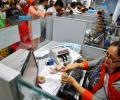
State Bank of India-led public sector banks posted a record cumulative profit of Rs 49,456 crore in the second quarter of the current fiscal, reflecting a 9 per cent year-on-year growth despite two lenders reporting a decline. All 12 public sector banks (PSBs) together made a profit of Rs 45,547 crore in the September quarter of FY25.

Digital payments provider PhonePe has filed draft papers with markets regulator Sebi for its upcoming initial public offering (IPO) using the confidential pre-filing route. On Wednesday, the company's spokesperson said, "PhonePe Ltd has filed the Pre-filed Draft Red Herring Prospectus with Sebi and the stock exchanges, under...the Sebi ICDR Regulations in relation to the proposed initial public offering of its equity shares on the main board of the stock exchanges".

Stock market participants would track global trends and foreign investors' trading activity in a holiday-shortened week ahead, amid lack of any major domestic trigger in sight, analysts said. Equity markets will remain closed on Wednesday for Christmas.

Trumponomics, poor growth, and high valuation certainly don't make a bullish recipe for Indian markets, warns Debashis Basu.

Dalal Street minnows stole the show in 2024, giving handsome returns to investors, helped by a largely optimistic trend in the stock market and impressive retail investors' participation. Analysts attributed the positive trend in the equity markets, where the benchmark indices shattered many records this year, to robust domestic liquidity, strong fundamentals of the Indian economy, and policy continuity.

'I don't think it is right to remove him over one lapse. The focus should be on restoring operations, not on removing a key management personnel.'

'India needs at least 70,000 to 80,000 eyewear stores; our 2,000 stores are just a drop in the ocean.'

Hindustan Unilever Ltd's (HUL's) second quarter 2025-26 (Q2FY26) consolidated revenue rose 2 per cent to Rs 16,250 crore, with low or flat volume growth. Demand remained stable but goods and services tax (GST) transition and prolonged monsoon hurt offtake.
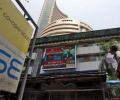
The stock markets, which had opened in the green on rate cut hopes, tumbled after the monetary policy announcement.

From the 30-share Sensex pack, Power Grid, Tata Steel, Zomato, Titan, Bajaj Finance, Mahindra & Mahindra, NTPC and Tata Motors were among the major laggards. Kotak Mahindra Bank, Bharti Airtel, HCL Tech, Tech Mahindra, ICICI Bank and Tata Consultancy Services were the gainers.

Equity benchmark indices Sensex and Nifty settled higher on Thursday, powered by a rally in banking and power stocks amid a largely firm trend in global markets. The stock markets mostly traded range-bound in the absence of any major trigger and persistent foreign capital outflows, traders said. The 30-share BSE Sensex rose 144.31 points, or 0.18 per cent, to settle at 81,611.41.

According to Standard & Poor's index services monthly global stock market review, global equity markets after three months of consecutive gains declined 0.58 per cent in June with emerging markets giving negative returns of 1.45 per cent. Indian stock markets gave the highest returns of as much as 60.6 per cent in the three months period between April to June, despite witnessing a loss of 2.17 per cent in the month of June.

U K Sinha said the equity market also helps in the growth of the Indian economy as the money invested in equities is utilised for infrastructure-building


Capital markets are becoming more prominent in India's growth story, with an expanding share in capital formation and investment landscape on the back of technology, innovation and digitisation, according to the Economic Survey 2023-24 tabled in Parliament on Monday. Further, Indian markets are resilient to global geo-political and economic shocks, it added. "Despite heightened geo-political risks, rising interest rates and volatile commodity prices, Indian capital markets have been one of the best performing among emerging markets in FY24," the Economic Survey said.

'The market's nervousness ahead of anticipated US tariffs has led to a significant downturn in Indian equities.'

Indian stock market investors are laughing all the way to the bank with the total market value of domestic listed companies soaring to a record $1.5 trillion on a day when the benchmark BSE Sensex ended at a new closing high of 25,396.46.

From the Sensex pack, Reliance Industries, Bajaj Finserv, HDFC Bank, Adani Ports, Maruti Suzuki India, Axis Bank, Hindustan Unilever, Sun Pharmaceuticals and Asian Paints were among the laggards. Reliance Industries fell the most by 2.38 per cent to close at Rs 1,171.10 apiece.
Notwithstanding the stock market in 2014 logging one of the worst New Year starts since 1996, the year heralds the beginning of a bull cycle in India and the Sensex may scale the 24,000 peak by December, Deutsche Equities said.

On average, stocks that debuted last year are down 37 per cent from their peak levels.

Retail investors have been the hardest hit in the recent market downturn, with stocks where they hold over 20% falling 45% from their 52-week highs.
Despite the rally in equities over the last few years, India, according to Christopher Wood, global head of equity strategy at Jefferies, is still in early stages of an equity cult. Any changes to the capital gains tax for equities - both long-term and short-term - in Budget 2024 scheduled to be announced on July 23, he believes, can trigger a bigger correction that what the markets witnessed post the Lok Sabha election outcome on June 4 that saw the Bharatiya Janata Party (BJP) lose majority, though it was able to form the government with the help of coalition partners.

When shorts are based on perceived corporate mismanagement or malfeasance, as in cases like Enron and Satyam, they enable the financial system to work efficiently, points out Devangshu Datta.

Reliance Industries Ltd, India's largest buyer of Russian oil and most impacted by the latest US sanctions, on Friday said it will comply with all applicable restrictions and will adjust its refinery operations to meet compliance requirements.

Foreign investors pulled out a massive Rs 94,000 crore (around $11.2 billion) from the Indian stock market in October, making it the worst-ever month in terms of outflows, triggered by the elevated valuation of domestic equities and attractive valuations of Chinese stocks. Before this, foreign portfolio investors (FPIs) withdrew Rs 61,973 crore from equities in March 2020. The latest outflow came after a nine-month high investment of Rs 57,724 crore in September 2024.

This is the longest winning streak for gold in the last three decades.

'It is advisable to stay away from the markets for now and buy only on a dip.'

Among Sensex firms, Tata Motors, Bharat Electronics, UltraTech Cement, Tech Mahindra, Mahindra & Mahindra, ICICI Bank, Tata Consultancy Services and Axis Bank were the major laggards. However, Power Grid, Hindustan Unilever, NTPC and HCL Tech were among the gainers.

Gold exchange-traded funds (ETFs) have further lost favour among Indian investors.

'This resilience should be viewed as reflecting the strength of the structural story.'

Markets regulator Sebi has barred US-based Jane Street Group from the securities markets and directed the group to disgorge unlawful gains of Rs 4,843 crore for allegedly manipulating stock indices through positions taken in derivatives segment. This could be the highest disgorgement amount ever directed by the Securities and Exchange Board of India (Sebi).

Trading sentiment in the equity market will largely be driven by domestic corporate quarterly earnings, any update related to US tariffs and foreign fund movements this week, analysts said. Investors would also focus on world market trends, movement of global oil benchmark Brent crude and the rupee-dollar trend for further cues, experts noted.

Raiwalys in existential crisis but no stock market route: Prabhu.

Indian stocks are becoming "less interesting" as their valuation vis--vis other markets in the Asian region have declined considerably, Swiss banking major Credit Suisse said in a report.

For investors who missed the initial IPO frenzy, the market correction is an opportunity to selectively invest in promising names, but patience and careful evaluation remain the key.

Do home prices really never fall? Ramalingam Kalirajan begs to differ.

Sebi has put in place a strong deterrence to check any misuse of participatory notes.

The company's market valuation stood at Rs 10,972 crore in morning trade.

But selectively, with regulatory scrutiny and special approval, points out Tamal Bandyopadhyay.

'While investors need to be prepared for making some losses, they should not lose big money chasing euphoria amid fear of missing out.'
 © 2026 Rediff.com - Advertise with us - Disclaimer - Privacy Policy - Sitemap - Feedback - About us - Terms of use - Grievances